
TUTORIAL: Making A Mystery Game Trailer
A full step-by-step guide to making the Reaplaced trailer

Happy Mystery Monday! In today's newsletter, you will:
Learn that Reaplaced is coming to Steam!
Watch the trailer for Reaplaced
Learn how I created the trailer, step-by-step!
Last week we announced Reaplaced, our community-made mystery game.
Today we are happy to announce Reaplaced is coming to Steam on October 23rd, 2023!
Please add it to your Steam wishlist to help us gain visibility!
A trailer, just like the one above, is a requirement for any game releasing on Steam.
Now I'm going to share with you exactly how I made that trailer, step by step:
Tools Used
Planning Phase
Project Setup
The Hook
Gameplay Clips
Call To Action
Music and Text
The full article is nearly 3,000 words long and provides a complete list of tools and how I used them in order to create the trailer, including a small Python script to help automate some busywork. I hope you find this valuable!
Tools Used:
VEGAS Pro ($143.88/year)
OBS Studio (free)
Paint.net (free)
ffmpeg (free)
Python (free)
Planning Phase
Whenever I create a trailer, I always start with planning ahead.
A good game trailer for Steam consists of three parts:
the hook
the gameplay
the call to action
The hook should immediately grab the customer's attention and hook them into the video. It should be something that immediately peaks someone's interest when they are scrolling by on the page.
The gameplay should consist of actual gameplay footage. Lots of visual novel developers tend to skimp out on this in favor of pre-rendered shots of the characters and backgrounds, but potential customers want to know what your gameplay actually looks like before buying.
The call to action goes at the end of the video. It's the part where you ask the customer to go and take some kind of action, usually in this case buying or wishlisting the game on Steam (or whatever storefront). If you don't include this part, the customer will immediately forget about your product without taking any action.
The trailer is literally a commercial. It is designed to hook people in, build up interest, and then ask them to go and do the thing you want them to do -- primarily, give you their money in exchange for the game.
Since Reaplaced is a free game, I made a few exceptions to these rules. You'll understand why as I go into more detail on each point.
Project Setup
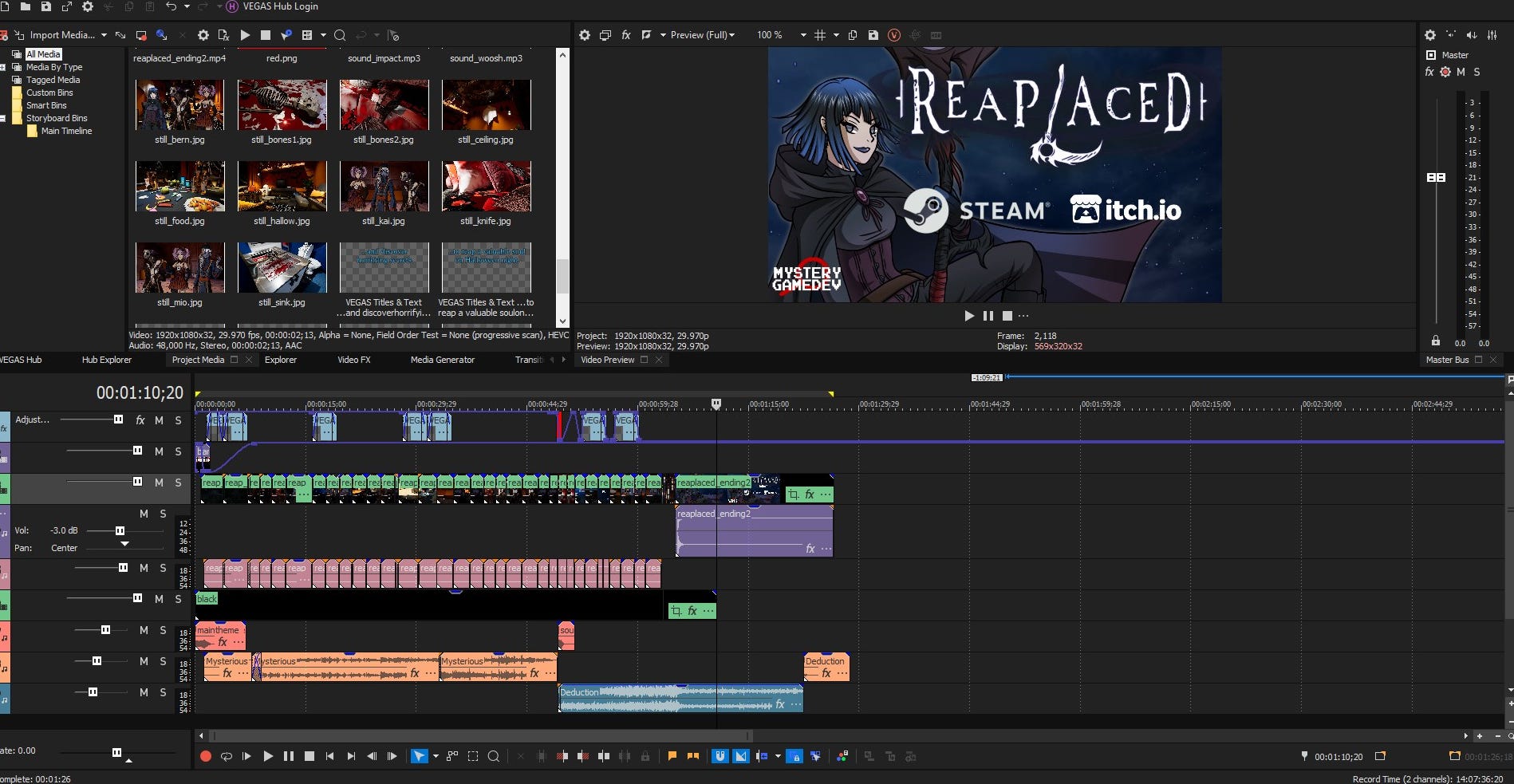
The tool I've been using for video editing for the past year is VEGAS Pro. At the time of writing, a subscription currently comes at a cost of $143.88. In my opinion, the features it provides is well worth the cost. OpenShot is a free alternative, but it has crashed too many times over the simplest of errors for me actually to recommend it.
I ended up creating three VEGAS projects for this trailer: the main project, a project dedicated to extracting clips from the gameplay footage, and a project dedicated solely to the call to action part at the end. I chose three projects for the sake of convenience: too many resources cluttering the timeline and made it hard to navigate, and I suspect it added lag to the preview window, too.
It's important to note that I actually started work on the call to action first, then gathered the gameplay footage, and then lastly created the intro. I prefer working backwards because it gives me a proper roadmap to follow. If you know where you're heading, you can plan your moves accordingly.
It's also important to note that I didn't necessarily finish one part before moving onto another. I switched back and forth multiple times in order to try out different ideas. Don't be afraid to do that for your own project, either.
For the sake of this article (and your convenience), I'll explain how to do things in chronological order.
The Hook
According to Tim Ruswick of Gamedev Underground, the average Steam customer only watches your trailer for 17 seconds — at most — before moving on. If you don't show anything hook-worthy before 17 seconds, the customer is assuredly gone.
Keep reading with a 7-day free trial
Subscribe to Mystery Gamedev to keep reading this post and get 7 days of free access to the full post archives.